


A page from the "Causes of Color" exhibit...
Why are the skies blue and the sunsets red?

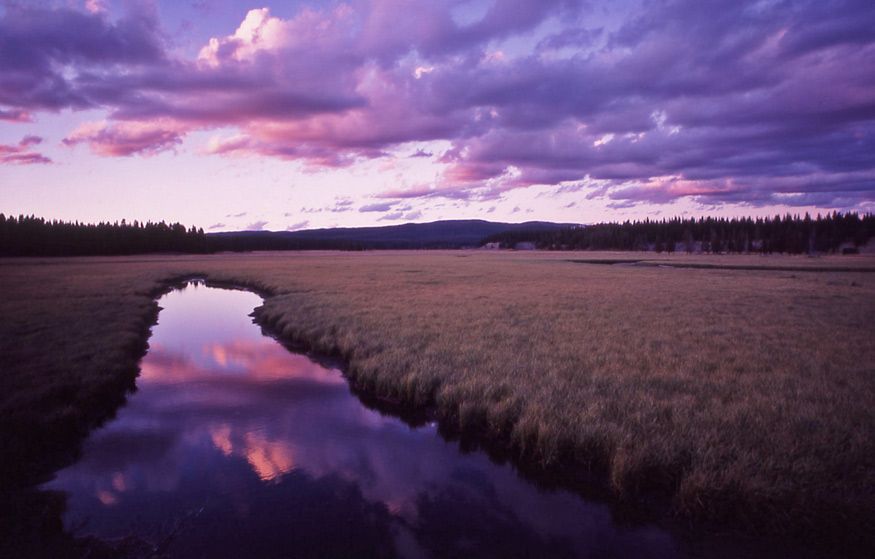
A brilliant red sunset fading into a bruised purple afterglow conjures up images of tropical paradise and romance, while the blue sky on a sunny day can put a bounce in your step. In fact, both are caused by light scattering through particles in the air.
Why is the sky blue, and sunsets red?
The color of our sky is caused by the interplay of blue-light scattering by air molecules, and white-light-scattering by water drops and dust...
 |
|||||||
 |
|
||||||
|
|||||||




Blue wavelengths are generally scattered down toward the earth. This makes the sky appear blue wherever it is daytime and the sun is high in the sky. At sunset, however, the opposite occurs.
Why are sunsets red?
When the sun is directly above you, the sun’s rays traverse a relatively short distance through the dense parts of the atmosphere until they reach your eye. According Rayleigh model of scattering, blue light is scattered by small particles and gases in the atmosphere to create the blue sky we perceive. In the distance, Mie scattering of all the wavelengths of sunlight by larger dust particles or clouds creates a paler blue in the lower part of the sky. In the absence of an atmosphere, we would see a black sky.
At sunset, the sun’s rays have much farther to travel through the atmosphere to reach your eye - more than 30 times the distance at midday. This increased distance amplifies the effect of the Rayleigh scattering that makes the sky blue, so that the violets and blues in sunlight are lost. The light you see is missing the violets and blues... leaving you with various shades of yellows, reds, and even purples.
The immense variation in the colors of sunsets depends on the concentration of small particles, or very small aerosols, in the atmosphere. In the absence of these small aerosols, the sky at sunset takes on yellow or orange hues, while increasing concentrations of small particles in the lower atmosphere further increase Rayleigh scattering to shift the hues towards the red end of the spectrum.
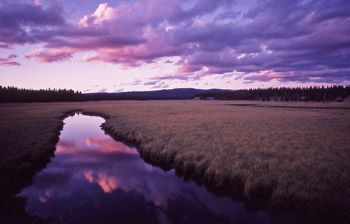
Purple after sunset
After sunset, the reddened evening sunlight illuminates small aerosols in higher altitudes of 10 km to 20 km above ground, in the lower stratosphere. This reddish light combines with blue scattered light to provide a purplish hue. Scattering by small aerosol particles (typically 100 nm to 1000 nm in diameter) contributes to the reddish-purple color of the late evening sky.
Another sunset phenomenon is the elusive green flash, briefly visible just as the sun disappears when conditions are right. The complex causes are explored in the section on dispersive refraction.
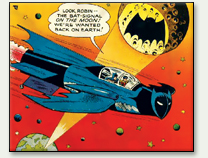
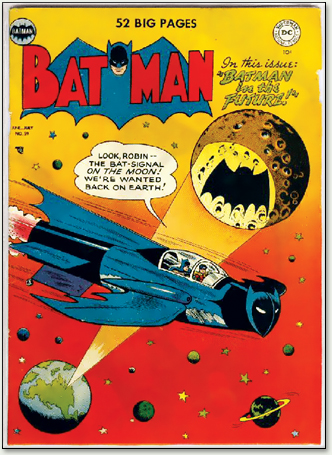
Glowing beam of the "bat signal", shown as imagined in a 1950s comic book cover. In reality, rays of light are invisible in the vacuum of space. In the earth’s atmosphere, however, the rays of our sun are faintly visible, spanning across our planet and appearing as a blue sky.

Leonardo da Vinci observed that a very fine water spray produced light scattering, but for many centuries only confusing and misleading theories abounded.
The English experimentalist John Tyndall (1820-1893) demonstrated that the scattering from particles that are small compared to the wavelength of light is wavelength-dependant, with blue being much more strongly scattered than red.
Small molecules make the sky blue
English physicist John William Strutt Lord Rayleigh (1842-1919) was the first to explain that particles were not necessary to scatter light, since even the purest of substances have fluctuations in their refractive index. Every gas molecule (mostly nitrogen and oxygen molecules) "scatters" light. When a particle is hit by a light wave, it creates a new wave that propagates in all directions. He also demonstrated that the intensity of the scattered light (Is) is related to that of the incident light (I0) by the inverse fourth power of the wavelength:
Is/Io = constant x-4
If we take the intensity of scattered violet light at the 400nm limit of visibility to be 100, then red light at 700 nm is scattered only at an intensity of 10.7. Blue is much more strongly scattered than red. The terms "Rayleigh scattering" and "Tyndall blue" are often applied to scattered blue light. A dark background, such as the dark of outer space, is required for an intense blue to be perceived.
Scattering in a gas, liquid, or glass
In a gas, liquid, or glass, the atoms and molecules are evenly distributed on a macroscopic scale, yet at the atomic level there is considerable non-randomness. For example, individual molecules, as well as small clusters in a gas or a liquid colliding for a brief instant before dispersing again, act as light-scattering particles, much as do particles of dust. In a glass there are similar density and refractive index variations, both from the imperfect mixing of the various ingredients as well as from the frozen-in liquid fluctuations. Even in what might be thought of as a perfectly ordered single crystal, there are usually a variety of point defects (impurity atoms, vacancies, and clusters of these) and line and plane defects (dislocations, low-angle grain boundaries, and the like), as well as density fluctuations from the thermal vibrations of the atoms or molecules - all of which scatter light.
Rayleigh scattering involves single light-emitting regions that are very small compared to the wavelength of light; they absorb light photons and re-emit them as single wavelets. Light is a form of electromagnetic radiation, and so has electric and magnetic field components. These fields oscillate as sinusoidal waves (waves in an undulating form with crests and troughs). The electric and magnetic field components are always in planes perpendicular to each other and in phase. Raleigh light scattered at 90 degrees is fully polarized, whereas at other angles it is only partly polarized.
Sunlight will consist of rays with the electric and magnetic field components in varying directions (not polarized), but because Rayleigh scattering occurs preferentially in one plane, the blue scattered light we see is polarized, perpendicular to the direction of the sun’s rays. Sometimes the initial scattered light is scattered again, so partial randomizing of the polarization occurs.