


A page from the "Causes of Color" exhibit...
Why are peacock feathers colored? (interference)

Behind the stunningly beautiful plumage of a peacock lies a complex structure that changes color with the angle of incident light.
Peacock feathers
In 1634, Sir Theodore de Mayerne, physician to Charles I, observed that the ‘eyes’ on the wings of the peacock butterfly "shine curiously like stars, and do cast about them sparks of the colour of the Rainbow; by these marks is it so known that it would be needless to describe the rest of the body though painted with a variety of colours."
|
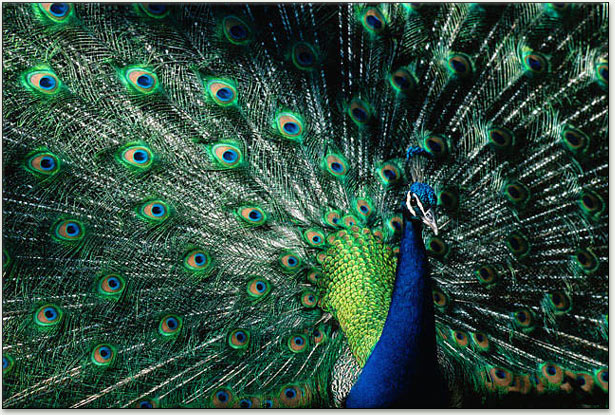
Peacock spreading its feathers. Every branch carries a series of brightly colored spots. The actual color depends on the exact position of the spot on the branch and on the angle of the incident light. |
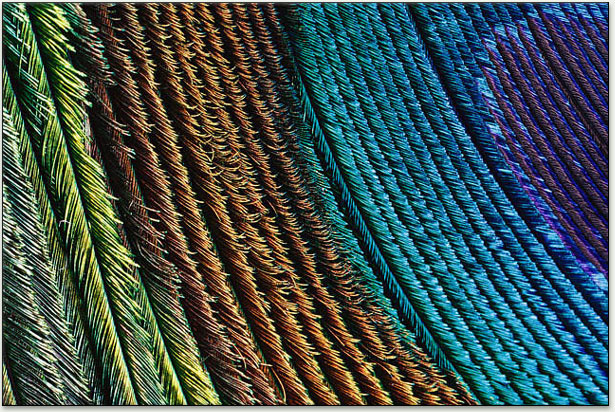
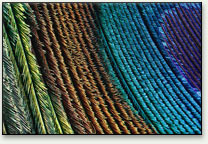
Detail of a peacock feather. The iridescent plumage of the peacock originates in the fine side branches of the feathers. |
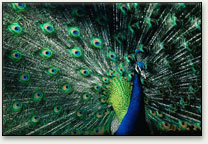
In general, the diversity of bird feathers’ colors can be explained by just two factors: pigments, and simple structures in the feathers that interfere with incident light. Pigment particles are embedded into the newly grown feathers during the molting season. They absorb light of certain wavelengths, or disperse the reflected light, and so contribute to the color of the plumage. Colors due to pigments are explained in the section about organic pigments. Here, we concentrate on structural colors caused by interference, which we can see in certain butterflies and moths, and most spectacularly in peacocks.
What is a peacock feather up close?
Each feather consists of thousands of flat branches (as shown above in the detail). When light shines on the feather, we see thousands of glimmering colored spots, each caused by minuscule bowl-shaped indentations. Stronger magnification reveals microscopic lamellae (thin plate-like layers) at the bottom of the indentations. As with butterfly wings, the regular pattern of the lamellae leads to interference phenomena and iridescent colors. The feathers of pheasants, birds of paradise, and hummingbirds create color using the same mechanism.
|
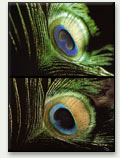
View at different angles. |
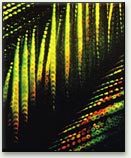
  
Underside of the feather. |
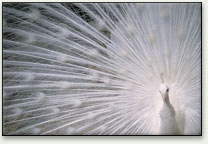
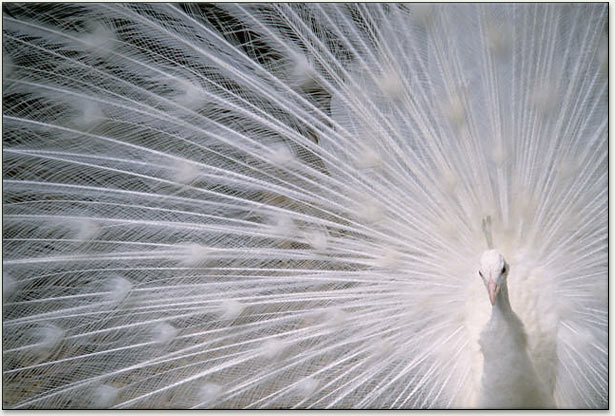
The white color of this unusual peacock is due to lack of dark pigment. The usual rich colors of the peacock are seen because black pigment absorbs most of the incident light, allowing us to see only the interference colors. In this peacock, the interference is present, but the effect is entirely washed out by the abundance of white light. Here you can see that the "eyes" of the tail feathers are transparent, not colored. |