


A page from the "Causes of Color" exhibit...
Why are glaciers blue? (vibrations & rotations)

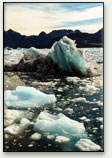
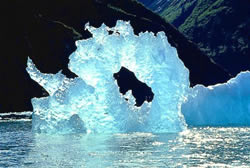
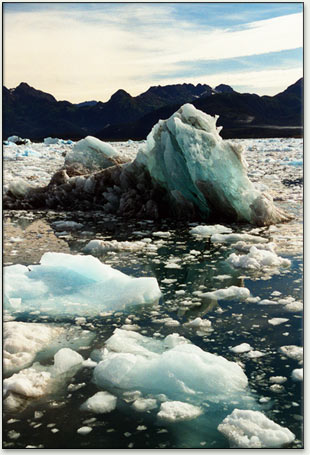
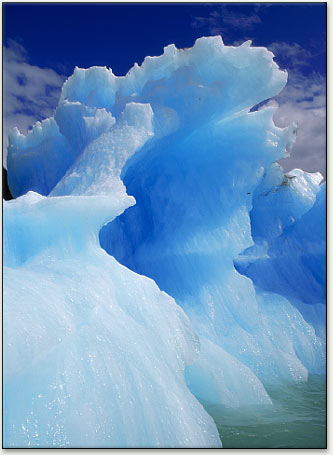
Icebergs floating near Seward and Tracy Arm, Alaska. Blue to blue-green hues are scattered back when light deeply penetrates frozen waterfalls and glaciers.
Puddle of water on a glacier (Lassen Volcanic National Park).
Majestic glaciers and thick snow banks act like filters that absorb red light, making a crevasse or deep hole appear blue.
What causes the blue color that sometimes appears in snow and ice?
As with water, this color is caused by the absorption of both red and yellow light (leaving light at the blue end of the visible light spectrum). The absorption spectrum of ice is similar to that of water, except that hydrogen bonding causes all peaks to shift to lower energy - making the color greener. This effect is augmented by scattering within snow, which causes the light to travel an indirect path, providing more opportunity for absorption.
From the surface, snow and ice present a uniformly white face. This is because almost all of the visible light striking the snow or ice surface is reflected back, without any preference for a single color within the visible spectrum.
The situation is different for light that is not reflected, but penetrates or is transmitted into the snow. As this light travels into the snow or ice, the ice grains scatter a large amount of light. If the light is to travel over any distance it must survive many such scattering events. In other words, it must keep scattering and not be absorbed. We usually see the light coming back from the near surface layers (less than 1 cm) after it has been scattered or bounced off other snow grains only a few times, and it still appears white.
In simplest of terms, think of the ice or snow layer as a filter. If it is only a centimeter thick, all the light makes it through; if it is a meter thick, mostly blue light makes it through. This is similar to the way coffee often appears light when poured, but much darker when it is in a cup.
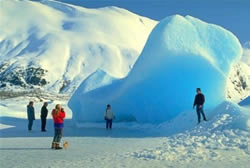
Deeper in the snow, the preferential absorption of red begins to become noticeable. Just as with water, more red light is absorbed compared to blue. Not much more, but enough that over a considerable distance, say a meter or more, photons emerging from the snow layer tend to be made up of more blue light than red light. This is typically seen when poking a hole in the snow and looking down into the hole to see blue light, or in the blue color associated with the depths of crevasses in glaciers. In each case the blue light is the product of a relatively long travel path through the snow or ice. This spectral selection is related to absorption, and not to reflection. |
Iceberg calved from Alaska’s Le Conte glacier. The more icy and clear an iceberg, the bluer it appears. The larger grain sizes of bubbly ice allows deeper penetration of incident light and a reflected hue that can vary from blue-green to blue depending on the color of the surface which underlies the ice. |
Does glacier ice last longer in drinks?
Yes, a little, because the ice crystals are larger. Crystals melt from the outside and large crystals expose less surface area per unit volume of ice; therefore, ice with larger crystals melts more slowly.