



A page from the "Causes of Color" exhibit...
What color is the Red Sea?

While the thought of wiggling your toes in the azure waters may be appealing, not all seas, oceans, and lakes are blue. Because of energy lost through vibrational effects, bodies of water usually appear blue. Some seas are pale blue while others are an intense, turquoise blue. Thanks to other influences such as cyanobacteria, water is sometimes green, red, or even brown.
Is the Red Sea red?
The Red Sea’s water is predominantly blue. There are a number of theories as to the origins of the name. Some believe it was named by early travelers because of the region’s reddish mineral-rich mountains. It is surrounded by a desiccated and largely barren landscape, and its hot, salty waters contain beautiful coral reefs. It may appear red in places because of reflections of the surrounding landscape, or reds in the coral on the seabed. As one early traveler noted, "In some places it is very green, in others white and yellow, according to the color of the earth or sand at the bottom."
|
The waters of the Red Sea are blue, though they may appear red due to reflections of the surrounding reddish landscape or reddish coral on its seabed. |
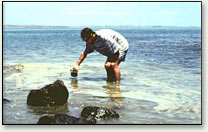
Scientist sampling a Trichodesmium bloom. The colors of the slick are sometimes vivid due to the photosynthetic pigments in the algae, including green chlorophyll and purple phycoerythrin. |

Today, it is widely accepted that the Red Sea is named for an occasional bloom of the cyanobacteria, Trichodesmium erythraeum algae, which clouds and muddies the usually translucent blue-green waters. These cyanobacteria appear as red and pinkish blankets on the surface of these waters. After blooming, the Trichodesmium erythraeum die, and they turn the sea reddish-brown.
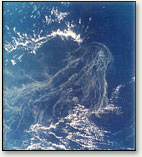
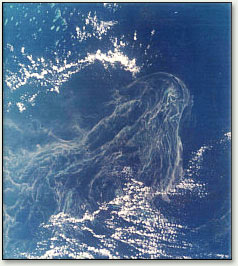
Vast slick of cyanophyte algae visible from space. The algal cells coalesce in strings and clumps. As the cells age, they become buoyant . In calm weather, the cells aggregate into huge slicks. (Australia)
Colors from Cyanobacteria
The relative abundance of phycobilin pigments, the reddish phycoerythrin and the blue phycocyanin, explain the color of cyanobacteria. Microscopically, the blue phycocyanin pigment, the green chlorophyll, and the accessory pigments give rise to blue-green algae. Species of cyanobacteria differ in their ratios of phyocyanin and phycoerythrin.
The appearance of a body of water changes drastically during a "bloom" of cyanobacteria, but the color is also not always due to pigments alone. For example, lakes in the Swiss Alps have been known to be turned blood-red by Oscillatoria rubescens blooms because they have refractive pseudovacuoles (not bounded by a tonoplast membrane) rather than by excessive phycoerythrin. While the Red Sea may have been named for its periodic blooms of Trichodesmium erythraceum, the aquatic disaster, red tide, is not caused by cyanobacteria, but instead by dinoflagellates (Pyrrophyta).
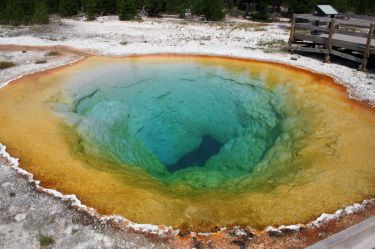
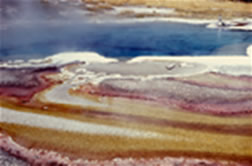
Cyanobacteria such as Hammatoidea, Heterohormogonium, Albrightia, Scytonematopsis, Thalopophila, Myxocarcina and Colteronema give thermal springs and geyser pools beautiful color patterns - from red to purple and the complete visible spectrum of colors between.
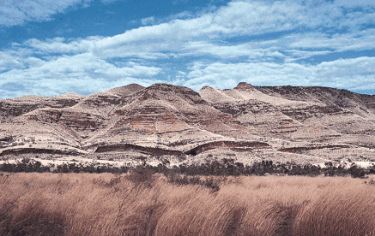

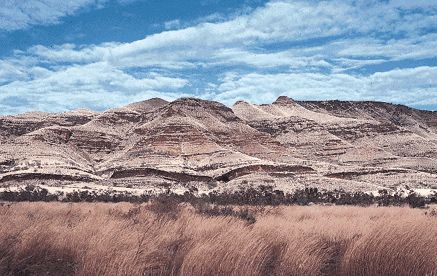
In ancient sedimentary rock, the transition to an aerobic atmosphere is marked by a shift in the color of the layers from gray to red. These cyanobacteria obviously marked the planet in a very permanent way. The change in rock colors marks a time about 2.5 billion years ago, at the end of the Archaean Era and the beginning of the Proterozoic Time.
Frequently, terrestrial "blooms" produce a gooey slime that is black in color because virtually all wavelengths of light are absorbed by the combination of chlorophyll and the accessory pigments. A disease of coral heads is caused by a cyanobacterium (Phormidium corallactinium) and is know as "black line disease." The rocks in the supralittoral fringe (splash zone) of many tropical shores are covered with epilithic (Scytonema, Gleocapsa and Pleurocapsa) or impregnated with endolithic (Mastigocoleus) cyanobacteria. This zone is often called the "black" zone because of the color of these cyanobacteria.
The first cyanobacteria (Cyanophyta) appear in fossils about 2.8 billion years old, and created the opportunity for evolution of more complex oxygen-reliant organisms. They have different biochemistry than Archaebacteria and were the first dominant organisms to use oxygenic photosynthesis. Their photosystem splits water and uses its electrons and protons to drive photosynthesis. As a byproduct of this new reaction system, oxygen gas (O2) was produced in abundance for the first time. This was a fundamental change in the Earth’s atmosphere, and its impact was observed in all surface layers. As cyanobacteria increased the levels of oxygen in the atmosphere, the iron in surface sediments was oxidized into red ferric oxide.