
WebExhibits
 Why are ruby, emerald, turquoise & red iron ore colored? (transition-metal impurities & compounds)									« »
 Emerald & ruby
Related pages:   Emerald & ruby   |   Blue sapphire   |   Vermilion   |   Blue diamonds   |   Amethyst

(This page is under development, and might be completed Fall 2002).

Diamonds, rubies and emeralds are among the most valued of gemstones.

The name ruby comes from the Latin "rubrum" meaning red. The ruby is in the Corundum group, along with the sapphire. The brightest red and thus most valuable rubies are usually from Burma. Violet red, sometimes quite dark, rubies come principally from Thailand. This is today's main source of rubies. Small quantities of rubies also come from Sri Lanka, Cambodia, Pakistan, India, and even Tanzania. Rubies have long been cherished among the world's most beautiful and valuable gems. The hardest mineral after diamond, and because of its brittleness, requires care when cutting. (http://www.gemcolor.com/gems/sap.html)

Why are diamonds colorless, rubies red and emeralds green?

The simplest and most distinctive gemstone is the diamond. It is strong, brilliant and colorless. It consists of an infinite array of carbon atoms linked in a rigid framework extending in all directions. This rigid framework makes diamond the hardest substance known. Diamonds, held together so tightly, are incapable of absorbing visible light and diamonds are therefore colorless.

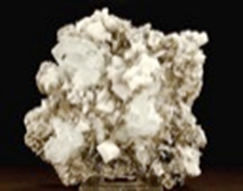
  • Figure: Colorless gemstones corundum and beryl.
  • Caption: Colorless gemstones corundum and beryl, like diamond, show similar properties characteristic of gemstones — brilliance, transparency and strength. They are pure substances, held together in similar strong frameworks.

For corundum the repeat unit is not carbon but aluminum oxide: as the second hardest material known, corundum is used for grinding steel in grinding wheels and emery paper. For beryl, the repeat unit is beryllium aluminum silicate. Not surprisingly, it is less hard: with four different types of element in its repeat unit (beryllium, aluminum, silicon and oxygen), the framework is less rigid.

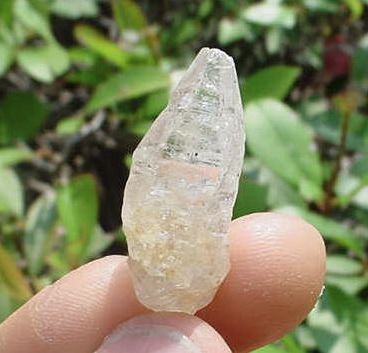
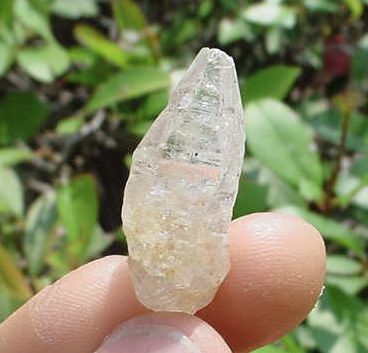
  • Figure: A pretty ruby crystal.
  • Caption: The ruby is a regular crystal of corundum containing chromium as an impurity.

These gemstones can become colored if the regularity of the framework is destroyed. For example, one of the atoms in the framework could be missing or one atom could be replaced by another slightly different atom. By such means diamonds can be colored blue (see other page). Rubies are red and emeralds green for the same reason. The ruby is a regular crystal of corundum containing chromium as an impurity. The emerald is a regular crystal of beryl also containing chromium as an impurity. ( Chromium and aluminum are very similar chemically and, in each case, an aluminum atom in the lattice is replaced by a chromium atom.) Why does the presence of the chromium impurity make the colorless corundum crystal red and the colorless beryl crystal green? Unlike the aluminum atom it has replaced, the chromium impurity can absorb light in the visible part of the spectrum (thereby making the crystal appear colored). What visible light the chromium impurity is capable of absorbing is determined by its immediate environment in the crystal. The environment in the corundum crystal differs from that in the beryl crystal … and that is why rubies and emeralds have different colors.

Why is ruby red and emerald green? The chromium can absorb a photon if the energy of the photon it absorbs exactly matches the energy needed to "jump" one of its electrons to a higher energy level. For energy to be conserved, the photon energy must match the "jump" energy, which is the difference in energy between the final state and the initial state of the electron. Without that energy match, energy cannot be conserved and the photon cannot be absorbed.

  • Figure: Fig 5.21 Williamson & modify
  • Caption:

Within the crystal framework, the chromium "impurity" or "guest" is held in the hole vacated by the aluminum it has replaced. It is held by bonding chemically — sharing its electrons — with the surrounding "host" molecules (aluminum oxide molecules in ruby, beryllium aluminum silicate in emerald). The strength of the bonding depends on the identity of the host and this will determine the energies of its energy levels. For ruby the relevant energy levels are shown in Figure (a). Illuminated with visible light, the chromium is able to make two transitions. By absorbing light in the green part of the spectrum, the energy match is just right to "jump" an electron initially in level 0 to level 2; and the match is also right for the absorption of violet light to jump another electron from level 0 to level 3. By removing green and violet light from the incident white, the ruby appears ruby, red with a tinge of blue.

In the emerald crystal, the geometry of the atoms is a little different, the host molecules interact with the chromium more weakly, and the energy differences between the energy levels are reduced. The 0—2 transition is now matched by the photon energy of yellow-red light; the 0—3 by blue light; and the emerald therefore appears green. In this way, the same impurity "guest" can produce different colors in different "host" crystals. The distinctive colors of many gemstones are caused by the presence of transition metals as impurities in an otherwise transparent crystal lattice. This is a so-called crystal-field or, alternatively, a ligand-field effect. The field exerted by the host crystal on the guest impurity fixes the energy levels of the latter photon absorber. Put another way, the chemical bonding between the host crystal and guest impurity always involves the donation of electrons on the crystal to empty energy levels on the metal impurity: the metal is bound thereby to the crystal and the crystal is the tie, ligand being the Latin for tie.

Gemstone Color Host crystal Impurity
Ruby Red Aluminum oxide (Corundum) Chromium
Emerald Green Beryllium aluminosilicate (Beryl) Chromium
Garnet Red Calcium aluminosilicate Iron
Topaz Yellow Aluminum fluorosilicate Iron
Tourmaline Pink-red Calcium lithium boroaluminosilicate Manganese
Turquoise Blue-green Copper phosphoaluminate Copper

Emeralds are the green, gem variety of the mineral beryl (Beryllium aluminum silicate). They are named after the Greek word "smaragdos" which means "a light green precious stone," and are generally regarded as among the most precious of the precious gems. Here are several postage stamps that have featured the emerald:

Afghanistan
13 afghani
5 Dec 1988

Colombia
5 pesos
1932-1939

Colombia
1.10 pesos
16 Jun 1972

Uganda
50 shilling
18 Jan 1988

Russia
10 kopecks
26 Dec 1963

What are they made of and why are emeralds green?

When water molecules are trapped in the channels of the gemstone emerald, the absorption spectrum clearly shows features that can be identified with these v1, v2, and v3 vibrations in the ultraviolet region at the left (diagram below), as well as overtones and combination tones at somewhat higher frequencies (higher energies, shorter wavelengths).


The absorption spectrum of colorless beryl (b) and emerald (e), including vibrational absorptions derived from water molecules and carbon dioxide.


An extremely high energy is required to excite paired electrons in most inorganic substances, resulting in electronic absorptions in the ultraviolet as in transparent glass. However, when unpaired electrons are present in transition-metal compounds, usually in d or f orbitals, then the absorptions can occur at lower energies. This leads to the ligand-field colors and provides the colors of many minerals and paint pigments. Similarly, in many substances, the transition metal may be only an impurity, typically present at the one percent level, thus providing the color in many of our gemstones and in some glass.

Consider a crystal of pure Al2O3, also known as corundum and as colorless sapphire when in gem-quality form. In this material each aluminum is surrounded by six oxygens in the form of a slightly distorted octahedron, as shown below left. All electrons are paired and there is no absorption of light. Now replace one out of every hundred aluminums by a chromium. Chromium in the trivalent state has 18 paired electrons in the 1s through 3p orbitals, but only three unpaired electrons in the 3d orbitals, which have the capacity to hold ten electrons. In an isolated triply charged chromium ion all the 3d electrons would occupy levels having the same energy, as shown in the central part the figure below right, so that, again, light- absorbing transitions could not occur.


The distorted-octahedral oxygen-ligand environment around an Al ion in corundum Al2O3 shown in two different ways, (A) and (B), and a regular octahedron (C).

 The splitting of the five 3d orbitals in a tetrahedral and an octahedral ligand field.

Such energy levels, however, are perturbed by the existence of the six neighboring oxygens - the "ligands" -- as above; both the geometrical distribution (here distorted octahedral) and the strength of the bonding (or the equivalent size of the electric field produced by the oxygen ions-the "crystal field" or "ligand field") affect the distribution and spacing of the levels, as indicated above. The study of the energy-level spacing and the transition rules is called ligand-field theory, which can also be viewed as a special case of the molecular-orbital theory discussed below; an earlier, less-sophisticated version was crystal-field theory.

Yellow beryl (Heliodor) is colored by the presence of F3+ ions. Beryl includes emerald , aquamarine, and lesser known varieties: goshenite (colorless), morganite (pink), Heliodor (yellow), and bixbite (red).

Red ruby. The name ruby comes from the Latin "Rubrum" meaning red. The ruby is in the Corundum group, along with the sapphire. The brightest red and thus most valuable rubies are usually from Burma. Violet

Green emerald. The mineral is transparent emerald, the green variety of Beryl on calcite matrix. 2.5 x 2.5 cm. Coscuez, Boyacá, Colombia.

The specific way in which 1 % or so Cr3+ions in Al2O3, usually called ruby, leads to color and fluorescence is shown in parts A through C of the figure below right. The symmetry of the ligand field and its strength combine to give the energy-level scheme, the "term diagram," at A and the transition scheme at B in Fig. 9. Here the violet and yellow-green regions of light passing through ruby are absorbed, as in the two upward arrows leading to the 4T1 and 4T2 levels, thus producing the absorption spectrum shown at C in the figure below right, and giving ruby its deep red color with purple (bluish) overtones.


The term diagram of Cr3+ in a distorted octahedral field (A), the energy levels and transitions in ruby (B), and the resulting absorption spectrum and fluorescence of ruby (C) and emerald (D).


In losing its energy again, the Cr3+ must pass through the state labeled 2E with the emission of some heat. In returning from 2E back down to the ground state, a quantum of red light, the red fluorescence of ruby, is emitted. This is best seen under ultraviolet illumination as in Plate IV; here the Cr3+ is excited into higher energy levels, not shown in the figure at right but nevertheless returns back down through the 2E level as required by the selection rules mentioned previously.

Consider now the circumstances when chromium is present in beryllium aluminum silicate Be2Al2Si6Ol8, known as beryl in the absence of chromium but as emerald in its presence. Here too the symmetry is distorted octahedral, but the ligand field is a little weaker, 2.05 eV instead of the 2.23 eV of ruby at A in the figure at right. This relatively small change produces a significant shift in the absorption bands, as shown at D in the figure above right, thus resulting in a change from the red color of ruby to the green color of emerald.

Interestingly enough, the position of the 2E level involved in the fluorescence does not change significantly with the ligand field, as can be seen at A in the figure above right, so that the same red fluorescence is present in both red ruby (strongly) and green emerald (weakly), as illustrated in below.


Absorption and fluorescence spectrum of colorless beryl (b) and emerald (e), including vibrational absorptions derived from water molecules and carbon dioxide. The red fluorescence in ruby is employed in the ruby laser.

Red fluorescence. Left: White-light, and Right: ultraviolet views of a mineral specimen from Franklin, New Jersey, containing calcite CaCO3 (tan color with red fluorescence) and willemite ZnSiO4 (brown with green fluorescence), both containing Mn2+ , as well as green synthetic emerald Be3Si6O18:Cr and red synthetic ruby Al2O3:Cr, both showing the red Cr3+ fluorescence; the ruby is 2 cm across.
 

With such a drastic change in color in going from ruby to emerald resulting from a relatively small change in the ligand field, one might wonder what would be the result of a ligand field intermediate between those of emerald and ruby. Nature has provided for us an answer to this question in the form of the extremely rare and precious gemstone alexandrite, an answer that demonstrates how she can confound our expectations and yet turn out to be perfectly reasonable in retrospect. The absorption bands are so delicately balanced in alexandrite that in blue-rich daylight or the similar-quality light from a fluorescent-tube lamp we see an intense blue-green color, somewhat resembling that of an emerald, while in red-rich candle light or the light from an incandescent lamp we perceive a deep-red color, somewhat resembling that of a ruby, as shown in Plate V. Nature has found a way of avoiding the almost-impossible task of providing a color truly intermediate between the green of emerald and the red of ruby!


PLATE V. A synthetic alexandrite gemstone, 5 mm across, changing from a reddish color in the light from an incandescent lamp to a greenish color in the light from a fluorescenttube lamp.

PLATE VI. The purple-orange dichroism (Cr3+ ligand-field colors) in a 3-cm-diameter synthetic ruby; the arrows indicate the electric vectors of the polarizers.

One result of the symmetry of the ligand field is "pleochroism," the existence of up to three colors in different directions in a crystal. The two "dichroic" colors, orange and purple, are seen with polarized light in a ruby, as shown in Plate VI.

As the chromium concentration of ruby is increased, there is a change from red through gray to green as the ligand field becomes weaker, as shown in Fig. 10; pure chromium oxide Cr2O3 is the dark-green pigment chrome green. A specimen on the red side of gray can be turned green by heating it to cause a reduction of the ligand field as the atoms move apart from thermal expansion in "thermochromism"; in the reverse "piezochromism," green can be turned red by the application of pressure.

FIG. 10. The variation of the ligand field and the color in the mixed system of colorless sapphire Al2O3 and chrome green Cr2O3.
 

Idiochromatic substances

Also sharing this mechanism are "idiochromatic" (selfcolored) transition-metal substances, including pigments such as the green viridian Cr2O(OH)4 and the chrome-oxide green mentioned above; the blue smalt glass K2CoSi3O8 and Thenard's blue, Al2CoO4; gems such as pink rhodochrosite MnCO3 and green malachite 2 CuCO3.Cu(OH)2; and minerals and ores such as brown manganite MnO(OH), red iron ore Fe2O3, yellow goethite FeO(OH), and green bunsenite NiO.

image: swatch viridian image: swatch chrome green image: swatch smalt image: swatch cobalt blue
link to pigment
link to painting
link to pigment
link to painting
link to pigment
link to painting
link to pigment
link to painting
image link mineral: rhodochrosite
image link mineral: malachite

Bisbee, Cochise Co., Arizona

image link: mineral manganite
image link: mineral goethite

Stellate crystalline aggregates of acicular Goethite crystals. Pribram, Bohemia, Czech Republic.

Source: The Mineral Gallery Source: Mineralogy database

Rhodochrosite from IC Minerals; Malachite from Minerals and Gemstone Kingdom

Small amounts of these same transition metals provide color in otherwise colorless substances in Mechanism 5; these are sometimes called "allochromatic" (other-colored). Examples include many gemstones such as the chromium based ruby, emerald, and alexandrite discussed above; the manganese-containing pink-colored morganite form of beryl; and the iron- colored blue and green aquamarines, yellow citrine, and green jade (in part). Some colors in glass, glazes, and enamels are also based on transition-metal compounds or impurities.

< Previous       Next >

Related pages:   Emerald & ruby   |   Blue sapphire   |   Vermilion   |   Blue diamonds   |   Amethyst
Look for:    
webexhibits.org/causesofcolor  -   Bibliography   -   Credits & Feedback
 
Home Other Moved light Lost light Made light Plant Animal vision Colorblindness Eye Opal Butterfly Sky & sunset Rainbow Neurological research Mind Early color theory Gold Fire Aurora Emerald Water Lightning Lightbulb Overview