


A page from the "Causes of Color" exhibit...
Color, Art and the Mind

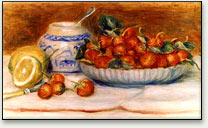
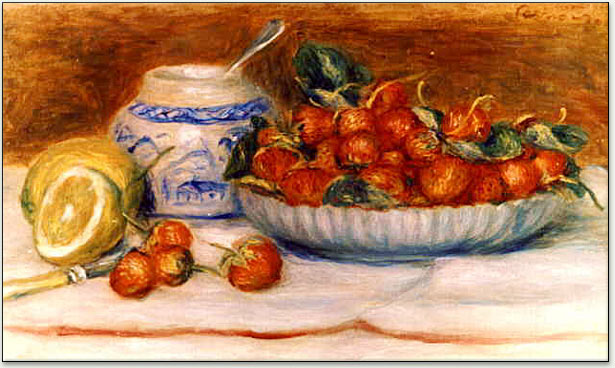
Color tells us whether strawberries are ripe, and sets the mood in paintings. "Strawberries" (c.1905) by Pierre-Auguste Renoir
What is color?
Color is a microconsciousness. Like our senses of taste and smell, color helps us to understand the world around us. While it gives us elementary survival skills, color also enriches our lives, allowing us to appreciate everything from the beauty of a rainbow, to the aesthetic pleasure of a painting.
In the late 19th and early 20th centuries, many artists explored the "essence" of things, and they divided the visual experience into components, such as "color" and "form," in a manner surprisingly similar to the way in which our brain processes information. Our mind continually seizes essential information from the rapidly changing images we see, distilling from the successive views the essential character of objects and situations. Jacques Riviere, the art critic, wrote, "The true purpose of painting is to represent objects as they really are, that is to say differently from the way we see them. It tends always to give us their sensible essence, their presence, this is why the image it forms does not resemble their appearance...." In other words, the appearance of objects changes from moment to moment. Neurologists agree with his point: the function of the visual brain is to represent objects as they really are, rather than to solely rely on the raw data that streams into our eyes.
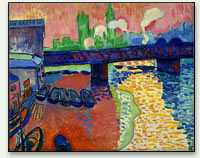
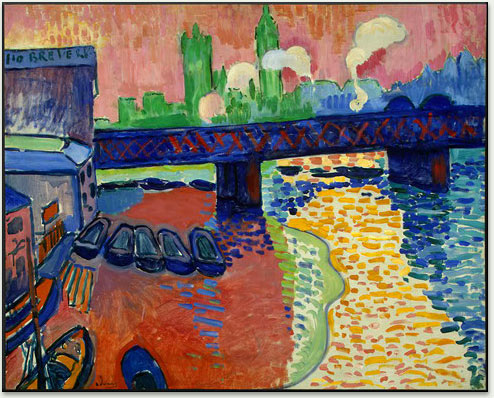
Artists have long recognized that color and luminance play different roles in visual perception. One of the goals of Fauvism (1905-1907) was to give color greater emotional and expressive power, an aim also pursued by non-Fauvist artists such as Frantisek Kupka and Adolf Hoelzel, who were more interested in non-iconic color abstraction. But what was color to be liberated from? The impossibility of liberating color from form on a two-dimensional canvas led the Fauvists to adopt the only physiologically viable solution: painting common objects and scenes in the "wrong" colors.
|
Fauve painters sought to "liberate" colors by investing objects with atypical colors, as in André Derain’s Charing Cross Bridge, London, (1906) |
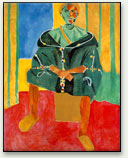
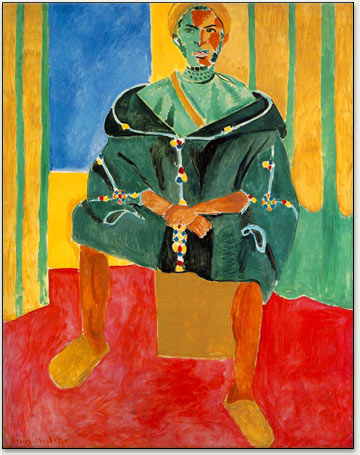
Seated Riffian (Le Rifain assis), 1913 by Henri Matisse. Matisse once said, "Underlying this succession of moments which constitutes the superficial existence of things and beings, and which is continually modifying and transforming them, one can search for a truer, more essential character, which the artist will seize so that he may give to reality a more lasting interpretation." |
Distortion of color was also explored by Pablo Picasso, who said, "Colors are only symbols. Reality is to be found in luminance alone." He also said, "When I run out of blue, I use red." Picasso’s Poor People on the Seashore is rendered in various blues that differ from each other in luminance but hardly at all in color (hue). The melancholy blue color serves an emotional role, but does not affect our recognition. The biological basis for the fact that color and luminance can play distinct roles in our perception of art, or of real life, is that color and luminance are analyzed by different subdivisions of our visual system, and these two subdivisions are responsible for different aspects of visual perception. The parts of our brain that process information about color are located several inches away from the parts that analyze luminance - as anatomically distinct as vision is from hearing.
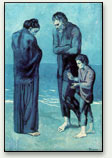
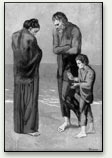
In Picasso’s Poor People on the Seashore (1903), our ability to recognize the figures and to perceive their three-dimensional shape and the spatial organization of this scene depends almost entirely on the luminance of the paints used, and not their colors. Left, is normal. Right is monochrome.
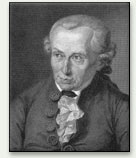
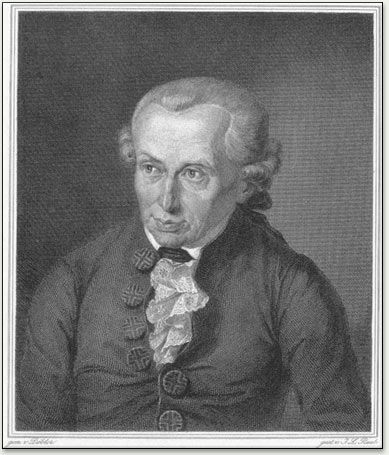
Immanuel Kant (1724-1804). Our mind acts in accordance with Kant’s (1783) statement in his Prolegomena: 'The Mind does not derive its laws (a priori) from nature, but prescribes them to her.’
The paintings by Derain and Picasso achieve their effect in part due to our color micro-consciousness. Seeing color is a complicated process that is more than just a recording of the wavelengths of light rays that reach our eyes. A banana would not appear as a banana each time we see it if it were not for color constancy. Color constancy makes us see a banana as yellow in different illuminations. Color constancy ensures that we do not see a piece of chalk on a cloudy day as having the same color as a piece of coal on a sunny day. If it were not for color constancy, we would perceive the banana or the chalk in different lights as having all possible shades that lie between black and white.
Color is a property of objects that our minds create - an interpretation. This interpretation helps us acquire knowledge about the properties of surfaces. To construct colors, our subconscious mind analyzes ratios of the signals from photoreceptors in the retina. Today, researchers are studying how the nerve cells in critical areas of the brain contribute to this process.