
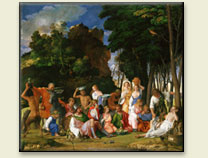
The Feast of the Gods was painted, and repainted, by three painters: Bellini, Dosso, and Titain (1518-1529).

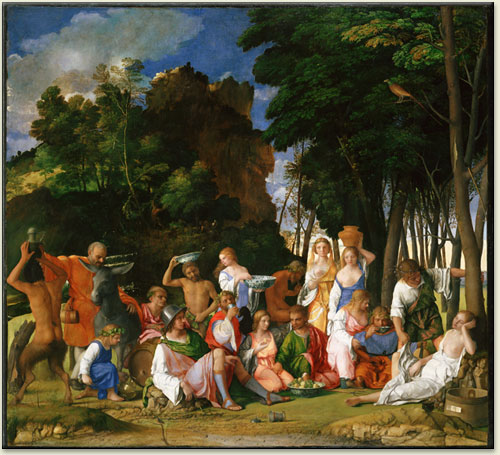
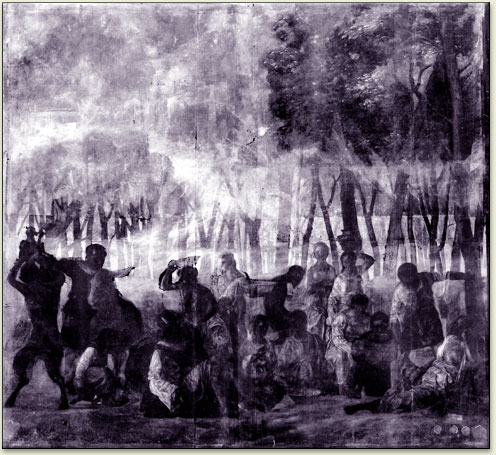
X-radiograph of the Feast of the Gods showing the presence of tree trunks from an eariler version of the painting. This interesting fact can be seen because the lead white pigment between the trees appears white in the X-ray image.
See also our full exhibit on the Feast of the Gods.
Introduction
Paintings are made of paint applied to a surface, commonly canvas, wood, or plaster. In most paintings, the pigments are suspended in the paint media. Common media include oil and egg yolk. Both substances undergo chemical change in the air, and convert into a plastic-like film. Although called "dying," what is really happening is a chemical change (so called "polymerization"), which makes the media hard.
The painting process for all forms of artist paints is similar in many ways. Generally speaking, first a surface is prepared, next a sketch is often drawn.
Click the links at left to follow the process of oil painting during the Renaissance in close detail. Today, steps preparing the canvas and making paint are often done in factories, and varnish step is often skipped.