

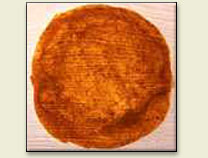
Brief description of Yellow ochre:
Earthtones from cream to brown. Yellow ochre is a natural mineral consisting of silica and clay owing its color to an iron oxyhydroxide mineral, goethite. It is found throughout the world, in many shades, in hues from yellow to brown. The best brown ochre comes from Cyprus. Used throughout history, this permanent pigment can be safely mixed with other pigments. Synthetic yellow ochre, Mars yellow, have been made since the early 1920s. Today, synthetic yellow ochree is used extensively by the paint, plastics and other industries.
Names for Yellow ochre:
| Alternative names: | Artificial variety: mars yellow | ||||||
| Word origin: | The name "Yellow ochre" comes from Greek ochros = yellow, pale yellow. | ||||||
| Non-English names: |
|
||||||
| Origin: | artificial | ||||||
| Chemical name: | Iron oxyhydroxide |
Example of use by artists:
Yellow Oche is deep in the painting
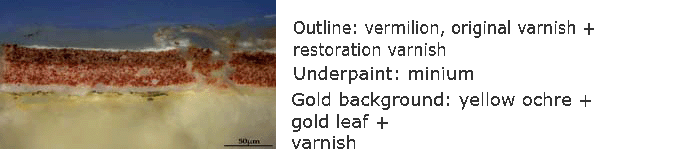
A. Akontatos workshop, Anne and Virgin, icon,middle of 15th Century. Cross section of a sample from the kighlight in Virgin’s tunic.
Microsamples (<<1mg) can be extracted from artworks and their cross section can be observed by Optical
Microscopy to reveal the existing stratigraphies and any later interventions on top of the original colouring layers. For instance, the painting techniques used in icons (15th – 17th cent.) of the Cretan School of iconography were investigated in detail using microsamples and the results revealed the rich variety of the materials and the sophisticated painting techniques applied by the painters of the Cretan School. Organic dyes, such as kermes, cochineal, madder, soluble redwood and indigoid dyes were used as exclusive colouring matters (or glazes) or in mixtures with inorganic pigments, such as yellow ochree, lead white and carbon black.
(intro) - Cadmium yellow/red - Chrome yellow - Cobalt yellow - Indian yellow - Lead-tin yellow - Lemon yellow - Naples yellow - Orpiment - Yellow ochre
 Sections: