

About the chemical structure:
| Chemical name: | Calcium copper silicate |
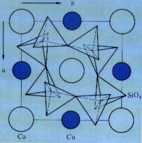
| Formula: | CaCuSi4O10 |
| 3D model: |
n/a |
| Crystal system: | Tetragonal - Ditetragonal Dipyramidal (at Mineralogy Database) |
| Refractive index: | e =1.59, w =1.633 |
Color:
| Color Index (C.I.) | PB 31 |
How can you identify Egyptian blue?
Imaging:
n/a
Analytics:
It's identified by means of FTIR and Raman.
Raman spectra: University College London;
FTIR spectra: IRUG
Usage and handling:
| Permanence: | Toxicity: |
|---|---|
Lightfast: excellent Degradation processes: very stable |
moderately toxic. Egyptian blue contains cooper, which is rated as toxic from prolonged exposure if inhaled or ingested. Care should be used in handling the dry powder pigment to avoid inhaling the dust. MSDS: Natural pigments |
Literature:
Chase, W T. "Egyptian Blue as a Pigment and Ceramic Material." In Science and Archaeology, edited by R. H. Brill. Cambridge: MIT Press, 1971, pp. 80-90.
Tite M. S., M. Bimson, and M. R. Cowell. "Technological Examination of Egyptian Blue." In Archaeological Chemistry III, edited by J. B. Lambert. Washington, D.C.: American Chemical Society, 1984, pp. 215-42.
Bayer, G. and Wiedemann, H.G.Bildung und Stabilität von Ägyptisch-Blau (Cuprorivait), Naturwissenschaften 62 (2), (1975), p. 181-2.
Bayer, G. and Wiedemann, H.G Ägyptisch Blau, ein synthetisches Farbpigment des Altertums, wissenschaftlich betrachtet, Sandoz-Bulletin 40 (1976), p. 20-39.
Artists’ Pigments. A Handbook of Their History and Characteristics, Vol. 3: E.W. Fitzhugh (Ed.) Oxford University Press 1997, p. 23-45
G. Accorsi, G. Verri, M. Bolognesi, N. Armaroli, C. Clementi, C. Miliani, A Romani, The exceptional near-infrared luminescence properties of cuprorivaite (Egyptian blue), Chem. Commun., 2009, 3392–3394 | 3393
(intro) - Azurite - Cerulean Blue - Cobalt blue - Egyptian blue - Prussian blue - Smalt - Ultramarine
 Sections: