

About the chemical structure:
| Chemical name: | Copper(II)-acetoarsenite |
| Formula: | |
| Crystal system: | monoclinic |
| Refractive index: | alpha = 1.71-2, beta = 1.77-8 |
Color:
| Color Index (C.I.) | this is not considered a pigment anymore because poisonous |
How can you identify Emerald green?
Imaging:
OM: microscopically, it appears as small rounded grains that are uniform in size making it readily distinguishable from Scheele's green. At high magnification, the grains are radial in structure and a dark spot can be seen in the center.
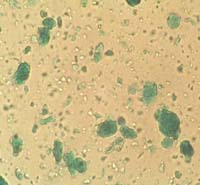
Microscopic appearance at x500 mag
Analytics:
It's identified by means of FTIR and Raman. It can be identified chemically by the stannous chloride test described for Scheele's green and has the same reaction for arsenic. In potassium hydroxide, it turns into an ochre color and in weak sulfuric acid it dissolves and turns blue.
Raman spectra: University College London;
FTIR spectra: IRUG;
Usage and handling:
| Permanence: | Toxicity: |
|---|---|
Lightfast: good. Degradation processes: it has the tendency to blacken on exposure to sulfur-bearing air. It rapidly blacken upon reaction with hydrogen sulphides in the atmosphere just as with the other copper-based greens. It could therefore not be mixed with sulfur-containing colors, such as cadmium yellow, vermilion or ultramarine blue. Emerald green was made more stable in a varnish medium. |
very toxic. No commercially available. If exposed to dampness it decomposed into arsine, a toxic gas |
Literature:
Artists’ Pigments. A Handbook of Their History and Characteristics, Vol. 3: E.W. Fitzhugh (Ed.) Oxford University Press 1997, p. 219-271
Andreas, H.Schweinfurter Grün, Chemie in unserer Zeit, 30, 1996 p. 23
The making of Cézanne’s palette Published in Helix magazine, X(2), 2001
Schweizer, F. und Mühletaler, B. Einige Grüne und Blaue Kupferpigmente, Farbe und Lack, 74 1968, p. 1159-73
(intro) - Cobalt green - Copper resinate - Emerald green - Green earth - Malachite - Verdigris - Viridian
 Sections: