

About the chemical structure:
| Chemical name: | Chromium(III)-oxide dihydrate |
| Formula: | Cr2O3 · 2 H2O |
| Crystal system: | probably hexagonal |
| Refractive index: | alpha and beta = 1.62; gamma = 2.12 |
Color:
| Color Index (C.I.) | PG 17 |
How can you identify Viridian?
Imaging:
UVF: no
IRFC: red/violet
OM: It is distinguished microscopically by its large particle size. Viridian's particles are slightly rounded. Bright green, transparent particles. Some can be quite large depending upon the manufacturing process. Large round crystals are a good indicator for this pigment although some samples may not provide characteristic crystals. Their intense colour is characteristic and should be true for all crystals. Particle size is usually 1-10μm.
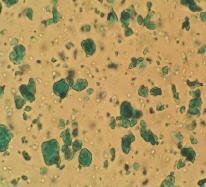
Microscopic appearance at x500 mag
Analytics:
It's identified by means of FTIR and Raman. The pigment is insoluble and unchanged in chemical tests.
Raman spectra: University College London;
FTIR spectra: IRUG
Usage and handling:
| Permanence: | Toxicity: |
|---|---|
Lightfast: very good. Degradation processes: good permanence. Excellent tinting strength and stability in all mediums. Unaffected by dilute alkalis and acids. Unaffected by light. |
moderately toxic. Though chomium oxide green is not a serious health hazard, it can cause irritation of the skin and eyes, and can cause nausea and other problems if ingested. It also can cause respiratory problems when dust is inhaled. It is not a fire hazard, and does not readily react with other materials. MSDS: Natural pigments |
Literature:
Artists’ Pigments. A Handbook of Their History and Characteristics, Vol. 3: E.W. Fitzhugh (Ed.) Oxford University Press 1997, p. 273 - 293
(intro) - Cobalt green - Copper resinate - Emerald green - Green earth - Malachite - Verdigris - Viridian
 Sections: